Question #19013

if tanθ+secθ=x, prove that sinθ=(X^2-1)(x^2+1)

Expert's answer

Conditions

if tanθ+secθ=x\tan \theta +\sec \theta = x, prove that sinθ=(X21)(x2+1)\sin \theta = (X^{\wedge}2 - 1)(x^{\wedge}2 + 1)

Solution

We must prove the following:


sinθ=((tanθ+secθ)21)((tanθ+secθ)2+1)\sin \theta = ((\tan \theta + \sec \theta)^2 - 1)((\tan \theta + \sec \theta)^2 + 1)


But this is not true for all θ\theta. For example, let's take θ=πi/4\theta = \pi i / 4. Then:


((tanθ+secθ)21)((tanθ+secθ)2+1)=((1+2)21)((1+2)2+1)=(1+2)4132.97\begin{array}{l} ((\tan \theta + \sec \theta)^2 - 1)((\tan \theta + \sec \theta)^2 + 1) = ((1 + \sqrt{2})^2 - 1)((1 + \sqrt{2})^2 + 1) \\ = (1 + \sqrt{2})^4 - 1 \approx 32.97 \end{array}


And this value must be equal to sinθ\sin \theta. But sinus is a bounded function in interval [-1,1]. So the equation is wrong.

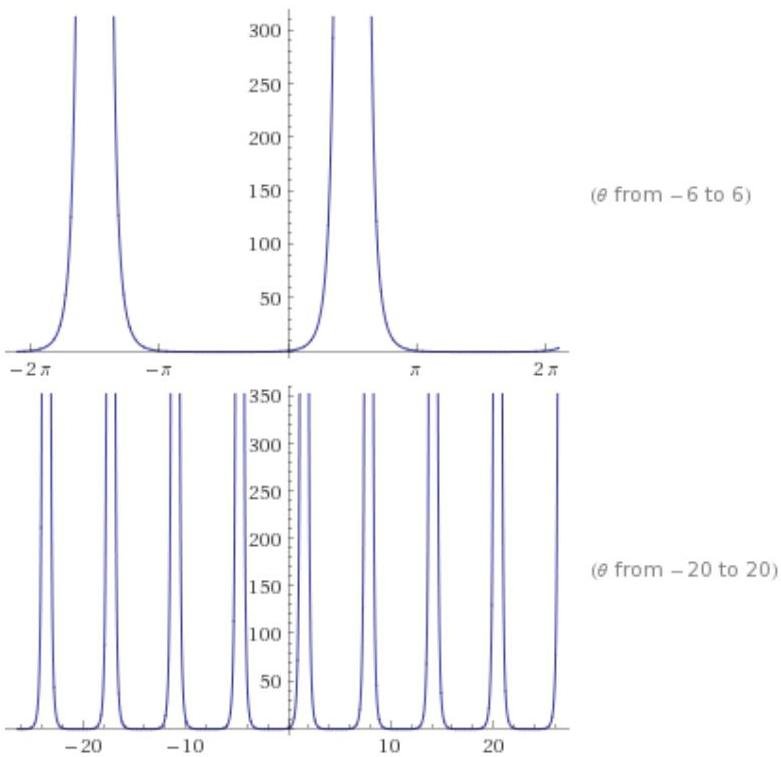
The graph of (tanθ+secθ)2+1(\tan \theta + \sec \theta)^2 + 1 is below:


As we see, the graph isn't bounded between -1 and 1 not only in 1 point.

Need a fast expert's response?

Submit order

and get a quick answer at the best price

for any assignment or question with DETAILED EXPLANATIONS!

LATEST TUTORIALS
APPROVED BY CLIENTS