Answer on Question #54355 – Math – Statistics and Probability
A car manufacturer takes an average of 17.5 hours to construct a car. This includes time for stamping, welding, painting, assembly and inspections. Construction times vary with a standard deviation of 30 minutes and these times follow a normal distribution.
a. Find the construction time of a car, which is on the 10th percentile of this distribution.
b. What is the probability that a randomly selected car manufactured at this plant takes between 18 and 19 hours to construct?
c. Find the probability that the construction time for a randomly selected car manufactured at this plant is less than 17 hours and 50 minutes.
Solution
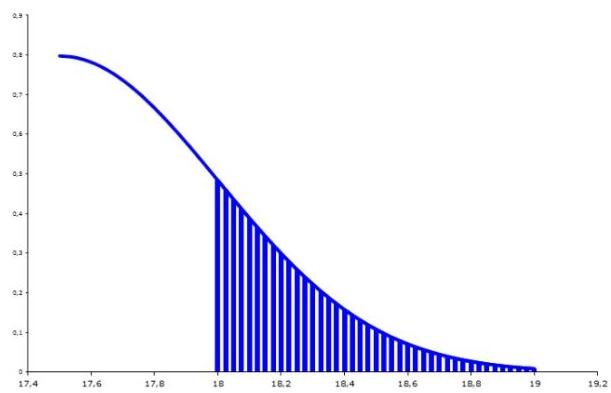
Method 1
We need to find a such that
P(X<a)=0.1,
where X∼N(17.5;(6030)2) is a random normally distributed variable.
Using Microsoft Excel 2013 type
=NORM.INV(0,1;17,5;0,5)
and the answer is 16.859.
Method 2
We need to find a such that
P(X<a)=0.1,
where X∼N(17.5;(6020)2) is a random normally distributed variable.
Using statistical tables or the command
=NORM.S.INV(0,1)
in Microsoft Excel 2013 obtain that 10th percentile of the standard normal variable is -1.282, P(Z<−1.282)=0.1.
It is known that
Z=sd(X)X−E(X),
where X∼N(17.5;(6030)2), Z∼N(0;1) are two random normally distributed variables.
Given times follow a normal distribution with the average of E(X)=17.5 hours and the standard deviation of sd(X)=6030=0.5 hour, equality
P(Z<−1.282)=0.1
is equivalent to
P(sd(X)X−E(X)<−1.282)=0.1,
or
P(X<−1.282sd(X)+E(X))=0.1,
i.e.
P(X<−1.282⋅0.5+17.5)=0.1,P(X<16.859)=0.1.
Thus, the construction time of a car, which is on the 10th percentile of this distribution, is 16.859 hours.
b. Method 1
We need to find probability
P(18<X<19),
where X∼N(17.5;(6030)2) is a random normally distributed variable.
Type
=NORM.DIST(19;17,5;0,5;TRUE)−NORM.DIST(18;17,5;0,5;TRUE)
in Microsoft Excel 2013 and the answer is 0.1573.
Method 2
It is known that
Z=sd(X)X−E(X),
where X∼N(17.5;(6030)2), Z∼N(0;1) are two random normally distributed variables.
Given times follow a normal distribution with the average of E(X)=17.5 hours and the standard deviation of sd(X)=6030=0.5 hour, the probability that a randomly selected car manufactured at this plant takes between 18 and 19 hours to construct is
P(18<X<19)=P(sd(X)18−E(X)<sd(X)X−E(X)<sd(X)19−E(X))=P(0.518−17.5<Z<0.519−17.5)==P(1<Z<3)=P(Z<3)−P(Z<1).
From z-table or using
=NORM.S.DIST(1;TRUE)
and
=NORM.S.DIST(3;TRUE)
in Microsoft Excel 2013 we know
P(Z<1)=0.84135;P(Z<3)=0.99865.
Thus,
P(18<X<19)=0.9987−0.8413=0.1573.
c.
Method 1
We need to find probability P(X<176050), where X∼N(17.5;(6030)2) is a random normally distributed variable.
Type
=NORM.DIST(17+50/60;17.5;0.5;TRUE)
in Microsoft Excel 2013 and the answer is 0.7475.
Method 2
It is known that
Z=sd(X)X−E(X),
where X∼N(17.5;(6030)2), Z∼N(0;1) are two random normally distributed variables.
Given times follow a normal distribution with the average of E(X)=17.5 hours and the standard deviation of sd(X)=6030=0.5 hour, the probability that the construction time for a randomly selected car manufactured at this plant is less than 17 hours and 50 minutes will be
P(X<176050)=P(sd(X)X−E(X)<sd(X)176050−E(X))=P(Z<0.5176050−17.5)==P(Z<0.5176050−176030)=P(Z<60⋅0.520)=P(Z<3020)=P(Z<0.667)=0.7475.
From z-table we know
P(Z<0.66)=0.7454;P(Z<0.67)=0.7486.
Type
=NORM.S.DIST(2/3;TRUE)
in Microsoft Excel 2013 and the answer is 0.7475.
Answer:
a. 16.859;
b. 0.1573;
c. 0.7475.
WWW.ASSIGNMENTEXPERT.COM



 #339914 on Dec 2023