Question #8304

Find the maclaurin series for sinx and cosx and show that they converge for all x to their respective functions.

Expert's answer

Let's consider a particular case of Taylor Series, in the region near x=0x = 0 . Such a polynomial is called the Maclaurin Series. The infinite series expansion for f(x)f(x) about x=0x = 0 becomes:


f(x)f(0)+f(0)x+f(0)2x2+f(0)3!x3+fiv(0)4!x4+f (x) \approx f (0) + f ^ {\prime} (0) x + \frac {f ^ {\prime \prime} (0)}{2} x ^ {2} + \frac {f ^ {\prime \prime \prime} (0)}{3 !} x ^ {3} + \frac {f ^ {\mathrm {i v}} (0)}{4 !} x ^ {4} + \dots


Let's find the Maclaurin Series expansion for f(x)=sinxf(x) = \sin x :


sinx=sin0+xcos0+x2sin02+x3cos03!+=x16x3+1120x515040x7+\sin x = \sin 0 + x \cos 0 + \frac {x ^ {2} \sin 0}{2} + \frac {x ^ {3} \cos 0}{3 !} + \dots = x - \frac {1}{6} x ^ {3} + \frac {1}{1 2 0} x ^ {5} - \frac {1}{5 0 4 0} x ^ {7} + \dots


and for f(x)=cosxf(x) = \cos x :


cosx=cos0+xsin0+x2cos02+x3sin03!+=112x3+124x41720x6+\cos x = \cos 0 + x \sin 0 + \frac {x ^ {2} \cos 0}{2} + \frac {x ^ {3} \sin 0}{3 !} + \dots = 1 - \frac {1}{2} x ^ {3} + \frac {1}{2 4} x ^ {4} - \frac {1}{7 2 0} x ^ {6} + \dots


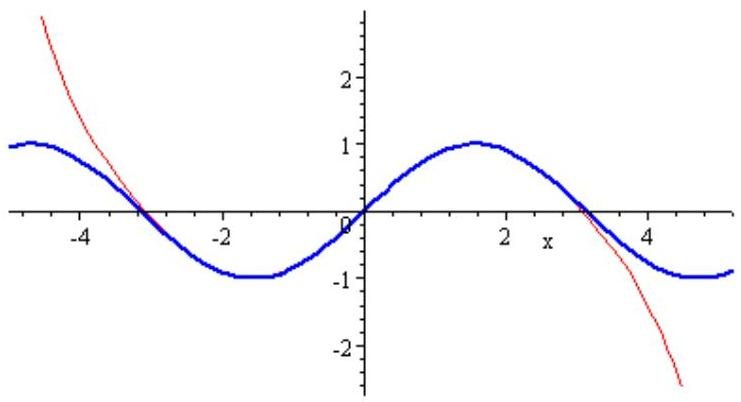
We plot our answer to see if the polynomial is a good approximation to f(x)=sinxf(x) = \sin x .


We observe that our polynomial (in red) is a good approximation to f(x)=sinxf(x) = \sin x (in blue) near x=0x = 0 . In fact, it is quite good between 3x3-3 \leq x \leq 3 . So, the statement that the Maclaurin series converge to their respective function for all xx is wrong.

Need a fast expert's response?

Submit order

and get a quick answer at the best price

for any assignment or question with DETAILED EXPLANATIONS!

LATEST TUTORIALS
APPROVED BY CLIENTS