Answer: Ellipse
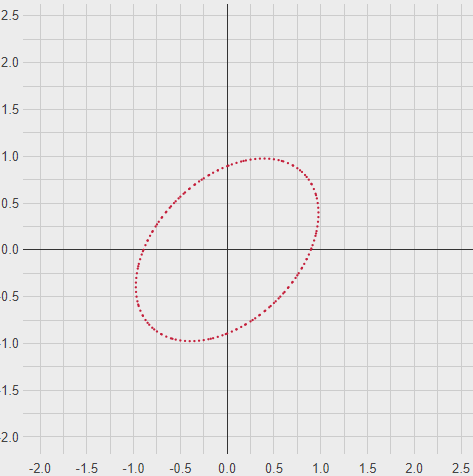
5 x 2 − 4 x y + 5 y 2 = 4 5x^2 - 4xy + 5y^2 = 4 5 x 2 − 4 x y + 5 y 2 = 4
If we draw a graph of this function we'll get:
Proof:
{ x = x 1 c o s ( ϕ ) − y 1 s i n ( ϕ ) y = x 1 s i n ( ϕ ) + y 1 c o s ( ϕ ) } \begin{Bmatrix}
x=x_1cos(\phi)-y_1sin(\phi) \\
y=x_1sin(\phi)+y_1cos(\phi)
\end{Bmatrix} { x = x 1 cos ( ϕ ) − y 1 s in ( ϕ ) y = x 1 s in ( ϕ ) + y 1 cos ( ϕ ) }
5 ( x 1 c o s ( ϕ ) − y 1 s i n ( ϕ ) ) 2 − 4 ( x 1 c o s ( ϕ ) − y 1 s i n ( ϕ ) ) ( x 1 s i n ( ϕ ) + y 1 c o s ( ϕ ) ) + 5 ( x 1 s i n ( ϕ ) + y 1 c o s ( ϕ ) ) 2 = 4 5(x_1cos(\phi)-y_1sin(\phi))^2-4(x_1cos(\phi)-y_1sin(\phi))(x_1sin(\phi)+y_1cos(\phi))+5(x_1sin(\phi)+y_1cos(\phi))^2=4 5 ( x 1 cos ( ϕ ) − y 1 s in ( ϕ ) ) 2 − 4 ( x 1 cos ( ϕ ) − y 1 s in ( ϕ )) ( x 1 s in ( ϕ ) + y 1 cos ( ϕ )) + 5 ( x 1 s in ( ϕ ) + y 1 cos ( ϕ ) ) 2 = 4
After simplifying we will write only expression with x 1 y 1 x_1y_1 x 1 y 1 and this expression equal to zero:
4 ( x 1 y 1 c o s 2 ( ϕ ) − x 1 y 1 s i n 2 ( ϕ ) ) = 0 4(x_1y_1cos^2(\phi) - x_1y_1sin^2(\phi))=0 4 ( x 1 y 1 co s 2 ( ϕ ) − x 1 y 1 s i n 2 ( ϕ )) = 0
cos 2 ( ϕ ) − sin 2 ( ϕ ) = 0 ; ϕ = π / 4 ; \cos^2(\phi)-\sin^2(\phi)=0;\\\phi=\pi/4; cos 2 ( ϕ ) − sin 2 ( ϕ ) = 0 ; ϕ = π /4 ;
{ x = x 1 c o s ( π / 4 ) − y 1 s i n ( π / 4 ) = x 1 2 − y 1 2 y = x 1 s i n ( π / 4 ) + y 1 c o s ( π / 4 ) = x 1 2 + y 1 2 } \begin{Bmatrix}
x=x_1cos(\pi/4)-y_1sin(\pi/4) =\frac{x_1}{\sqrt{2}} - \frac{y_1}{\sqrt{2}} \\
y=x_1sin(\pi/4)+y_1cos(\pi/4)=\frac{x_1}{\sqrt{2}} + \frac{y_1}{\sqrt{2}}
\end{Bmatrix} { x = x 1 cos ( π /4 ) − y 1 s in ( π /4 ) = 2 x 1 − 2 y 1 y = x 1 s in ( π /4 ) + y 1 cos ( π /4 ) = 2 x 1 + 2 y 1 }
and we will get:
3 x 1 2 4 + 7 y 1 2 4 = 1 \frac{3x_1^2}{4} + \frac{7y_1^2}{4} =1 4 3 x 1 2 + 4 7 y 1 2 = 1
This is an equation of the ellipse.
Comments

