Answer on Question #53419 – Math – Integral Calculus
Question
Find the area of the region that lies inside the first curve and outside the second curve. r2=18cos2θ,r=3
Solution
Definition
Let G be the region bounded by curves with polar equations r=f(ϑ) and r=g(ϑ) (fig.1), ϑ=a and ϑ=b, where f(ϑ)≥g(ϑ)>0, 0<b−a≤2π. Then area A of G is
A(G)=21∫ab([f(ϑ)]2−[g(ϑ)]2)dϑ.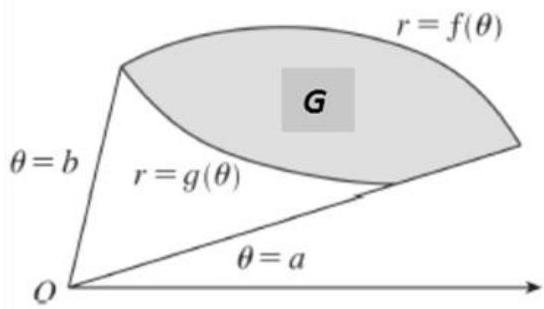
Fig.1
First we describe the given curves in polar coordinates {r,ϑ}:
1) r2=18cos(2ϑ) is the lemniscate of Bernoulli;
2) r=3 is a circle with radius 3 and the center at the pole (origin).
Further we sketch these curves (fig.2). The required area is represented by the shaded regions.
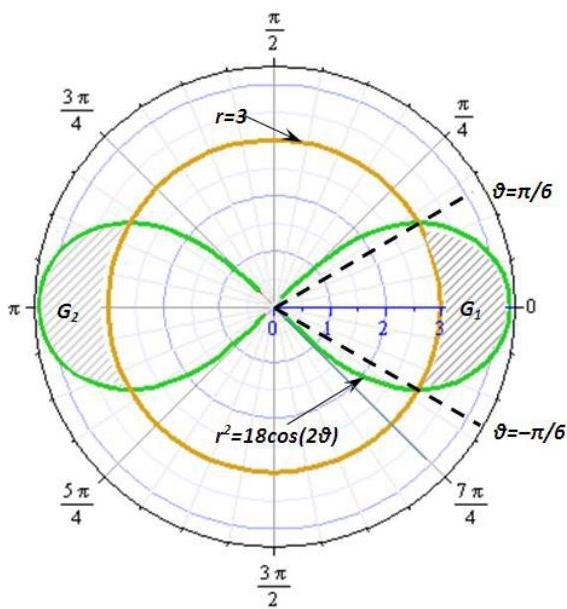
Fig.2
As we can see,
A(G)=A(G1)+A(G2).
As the figures in the fig.2 are symmetrical, then we can write
A(G)=2A(G1).
Let's find points of intersection of the curves 1) and 2) for region G1:
±18cos(2ϑ)=3,18cos(2ϑ)=9,cos(2ϑ)=189=21,2ϑ=±arccos(21)=±3π,θ1,2=±6π.
Therefore, using (1), (2) and (3) we obtain
A(G)=2⋅21∫−6π6π(18cos(2ϑ)−32)dϑ=∫−6π6π(18cos(2ϑ)−9)dϑ=(sin(2⋅6π)−(sin(2⋅(−6π)))−(6π−(−6π)))=9(2sin(2⋅6π)−62π)=18(sin(3π)−6π)=18(23−6π)≈6.16 square units.
Answer: A(G)=6.16 square units.
www.AssignmentExpert.com



