Question #42376

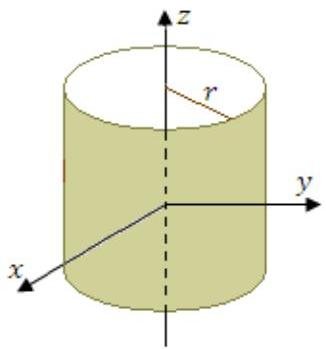
Evaluate the integral of f(x,y,z) = x+2y-z over the cylinder bounded by x2 +y2 =4 and z=1 .

Expert's answer

Answer to Question #42376 - Math - Integral Calculus

Question: Evaluate the integral of f(x,y,z)=x+2yzf(x, y, z) = x + 2y - z over the cylinder bounded by x2+y2=4x^2 + y^2 = 4 and z=1z = 1.

Solution. For this solution, it is assumed that the cylinder is bounded below by z=0z = 0.


It is most convenient to calculate the integral


x2+y240z1(x+2yz)dx dy dz\iiint_{\substack{x^{2} + y^{2}\leq 4\\ 0\leq z\leq 1}}(x + 2y - z)dx\ dy\ dz


using the cylindrical coordinates r,θ,zr, \theta, z:


{x=rcosθy=rsinθz=z\left\{ \begin{array}{l} x = r \cos \theta \\ y = r \sin \theta \\ z = z \end{array} \right.


In terms of cylindrical coordinates, dV=dx dy dz=r dθ dr dzdV = dx\ dy\ dz = r\ d\theta\ dr\ dz.

Furthermore, the cylinder {(x,y,z):x2+y24,0z1}\{(x,y,z): x^2 + y^2 \leq 4, 0 \leq z \leq 1\} becomes {(r,θ,z):0r2,0θ2π,0z1}\{(r,\theta,z): 0 \leq r \leq 2, 0 \leq \theta \leq 2\pi, 0 \leq z \leq 1\}, and the function to integrate is f(r,θ,z)=r(cosθ+2sinθ)zf(r,\theta,z) = r(\cos\theta + 2\sin\theta) - z.

Thus, we have


x2+y240z1(x+2yz)dx dy dz==0102π02(r(cosθ+2sinθ)z)r dθ dr dz=02π02(r2(cosθ+2sinθ))rz22)z=0z=1dθ dr=0202π(r2(cosθ+2sinθ)r2)dθ dr==0202π(r2(cosθ+2sinθ)r2)dθ dr==02π(r33(cosθ+2sinθ)r24)r=0r=2dθ=02π(83(cosθ+2sinθ)44)dθ=(83sinθ163cosθθ)θ=0θ=2π=1632π+163=2π.\begin{array}{l} \iiint_{\substack{x^{2} + y^{2}\leq 4\\ 0\leq z\leq 1}}(x + 2y - z)dx\ dy\ dz = \\ \quad = \int_{0}^{1} \int_{0}^{2\pi} \int_{0}^{2} (r(\cos\theta + 2\sin\theta) - z)r\ d\theta\ dr\ dz = \int_{0}^{2\pi} \int_{0}^{2} (r^{2}(\cos\theta + 2\sin\theta)) \\ \quad - r \frac{z^{2}}{2}) \Big|_{z=0}^{z=1} d\theta\ dr = \int_{0}^{2} \int_{0}^{2\pi} (r^{2}(\cos\theta + 2\sin\theta) - \frac{r}{2}) d\theta\ dr = \\ \quad = \int_{0}^{2} \int_{0}^{2\pi} (r^{2}(\cos\theta + 2\sin\theta) - \frac{r}{2}) d\theta\ dr = \\ \quad = \int_{0}^{2\pi} \left(\frac{r^{3}}{3}(\cos\theta + 2\sin\theta) - \frac{r^{2}}{4}\right) \Big|_{r=0}^{r=2} d\theta = \int_{0}^{2\pi} \left(\frac{8}{3}(\cos\theta + 2\sin\theta) - \frac{4}{4}\right) d\theta \\ \quad = \left(\frac{8}{3} \sin\theta - \frac{16}{3} \cos\theta - \theta\right) \Big|_{\theta=0}^{\theta=2\pi} = -\frac{16}{3} - 2\pi + \frac{16}{3} = -2\pi. \end{array}


Answer. 2π-2\pi.

www.AssignmentExpert.com


Need a fast expert's response?

Submit order

and get a quick answer at the best price

for any assignment or question with DETAILED EXPLANATIONS!

LATEST TUTORIALS
APPROVED BY CLIENTS