Question #43544

Prove that in a parallelepiped the sum of the diagonals is equal to the sum of the squares on the edges.

Expert's answer

Answer on Question #43544 – Math – Geometry

Prove that in a parallelepiped the sum of the diagonals is equal to the sum of the squares on the edges.

Proof.

A parallelepiped is a three-dimensional geometric solid with six faces that are parallelograms.
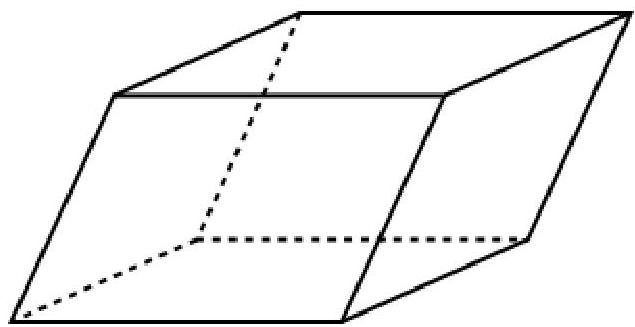


Parallelograms which is composed of a parallelepiped, called its faces, their side - ribs, and the vertices of parallelograms - tops the parallelepiped.

Based on the definition of a parallelepiped, we know that the sides are parallelograms, and hence in the proof will be guided with parallelogram properties.

We solve the auxiliary problem: we establish a relationship between the sides of parallelogram and its diagonals.

We proceed from the fact that the diagonal cross-section parallelepiped - parallelogram.

For parallelogram true each of the following statements:

- The opposing sides are equal in pairs;

- Opposite angles are equal;

- Diagonals intersect and bisect the intersection point;

- The opposing sides are parallel;

- The sum of angles adjacent to the one side, is 180180{}^{\circ}

- Each diagonal divides the parallelogram into two congruent triangles.

Consider the following parallelogram ABCD.
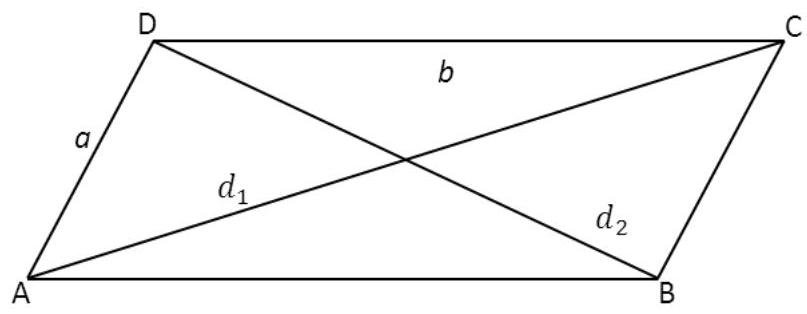


We have AC=d1,DB=d2,AD=BC=a,AB=DC=b,DAB=α\mathrm{AC} = \mathrm{d}_1, \mathrm{DB} = \mathrm{d}_2, \mathrm{AD} = \mathrm{BC} = \mathrm{a}, \mathrm{AB} = \mathrm{DC} = \mathrm{b}, \angle \mathrm{DAB} = \alpha

Then ADC=180α\angle ADC = 180{}^{\circ} - \alpha

For triangle Δ\Delta DAB we note the law of cosines.


d22=a2+b22abcos(α)\mathrm {d} _ {2} ^ {2} = \mathrm {a} ^ {2} + \mathrm {b} ^ {2} - 2 \mathrm {a b} \cdot \cos (\alpha)


Then we consider the triangle Δ\Delta ADC and write for them the law of cosines.


d12=a2+b22abcos(180α)=a2+b2+2abcos(α)\mathrm {d} _ {1} ^ {2} = \mathrm {a} ^ {2} + \mathrm {b} ^ {2} - 2 \mathrm {a b} \cdot \cos (1 8 0 {}^ {\circ} - \alpha) = \mathrm {a} ^ {2} + \mathrm {b} ^ {2} + 2 \mathrm {a b} \cdot \cos (\alpha)


Adding these equations, we obtain:


d12+d22=a2+b2+2abcos(α)+a2+b22abcos(α)\mathrm {d} _ {1} ^ {2} + \mathrm {d} _ {2} ^ {2} = \mathrm {a} ^ {2} + \mathrm {b} ^ {2} + 2 \mathrm {a b} \cdot \cos (\alpha) + \mathrm {a} ^ {2} + \mathrm {b} ^ {2} - 2 \mathrm {a b} \cdot \cos (\alpha)


Simplify the obtained equation.


d12+d22=2a2+2b2\mathrm {d} _ {1} ^ {2} + \mathrm {d} _ {2} ^ {2} = 2 \mathrm {a} ^ {2} + 2 \mathrm {b} ^ {2}


Consider the parallelepiped AA1DD1CC1BB1AA_{1}DD_{1}CC_{1}BB_{1} to prove statement from the condition of the given task.

Let the edges of the parallelepiped are a, b, c.
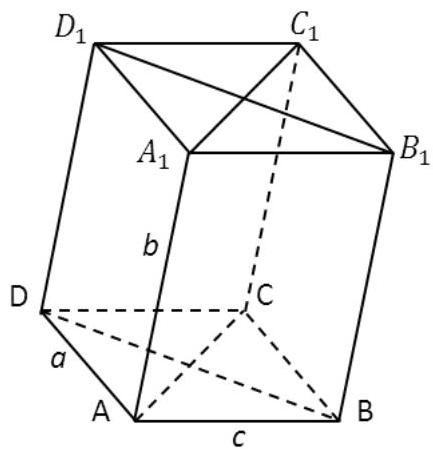


For the plane DD1B1B\mathrm{DD}_1\mathrm{B}_1\mathrm{B} write the formula that we determined of the sum of the diagonals.


D1B2+DB12=2DB2+2BB12\mathrm {D} _ {1} \mathrm {B} ^ {2} + \mathrm {D B} _ {1} ^ {2} = 2 \mathrm {D B} ^ {2} + 2 \mathrm {B B} _ {1} ^ {2}


Then we consider the plane AA1C1C\mathrm{AA}_1\mathrm{C}_1\mathrm{C} write the formula that we determined of the sum of the diagonals.


A1C2+AC12=2AC2+2AA12\mathrm {A} _ {1} \mathrm {C} ^ {2} + \mathrm {A C} _ {1} ^ {2} = 2 \mathrm {A C} ^ {2} + 2 \mathrm {A A} _ {1} ^ {2}


Now we add obtained earlier equalities:


D1B2+DB12+A1C2+AC12=2DB2+2BB12+2AC2+2AA12\mathrm {D} _ {1} \mathrm {B} ^ {2} + \mathrm {D B} _ {1} ^ {2} + \mathrm {A} _ {1} \mathrm {C} ^ {2} + \mathrm {A C} _ {1} ^ {2} = 2 \mathrm {D B} ^ {2} + 2 \mathrm {B B} _ {1} ^ {2} + 2 \mathrm {A C} ^ {2} + 2 \mathrm {A A} _ {1} ^ {2}


Now, to solve this equation we make the change of the sides.

Accordance with the terms of the problem, we noted the following.


DB=d2 and AC=d1\mathrm {D B} = \mathrm {d} _ {2} \text { and } \mathrm {A C} = \mathrm {d} _ {1}


We have already identified that d12+d22=2a2+2c2\mathrm{d}_1^2 + \mathrm{d}_2^2 = 2\mathrm{a}^2 + 2\mathrm{c}^2 .

Now we can rewrite the equation.


D1B2+DB12+A1C2+AC12=2DB2+2BB12+2AC2+2AA12=2(DB2+AC2)+2BB12+2AA12\begin{array}{l} D _ {1} B ^ {2} + D B _ {1} ^ {2} + A _ {1} C ^ {2} + A C _ {1} ^ {2} = 2 D B ^ {2} + 2 B B _ {1} ^ {2} + 2 A C ^ {2} + 2 A A _ {1} ^ {2} \\ = 2 \left(\mathrm {D B} ^ {2} + \mathrm {A C} ^ {2}\right) + 2 \mathrm {B B} _ {1} ^ {2} + 2 \mathrm {A A} _ {1} ^ {2} \\ \end{array}


According to the condition of the task we also know that BB1=AA1=b\mathrm{BB}_1 = \mathrm{AA}_1 = \mathrm{b} .

So, we can substitute into the equation.


D1B2+DB12+A1C2+AC12=2(2a2+2b2)+2b2+2b2\mathrm {D} _ {1} \mathrm {B} ^ {2} + \mathrm {D B} _ {1} ^ {2} + \mathrm {A} _ {1} \mathrm {C} ^ {2} + \mathrm {A C} _ {1} ^ {2} = 2 (2 \mathrm {a} ^ {2} + 2 \mathrm {b} ^ {2}) + 2 \mathrm {b} ^ {2} + 2 \mathrm {b} ^ {2}


Simplify and combine like terms on the right side of the equation.


D1B2+DB12+A1C2+AC12=2(2a2+2c2)+2b2+2b2=4a2+4c2+4b2\mathrm {D} _ {1} \mathrm {B} ^ {2} + \mathrm {D B} _ {1} ^ {2} + \mathrm {A} _ {1} \mathrm {C} ^ {2} + \mathrm {A C} _ {1} ^ {2} = 2 (2 \mathrm {a} ^ {2} + 2 \mathrm {c} ^ {2}) + 2 \mathrm {b} ^ {2} + 2 \mathrm {b} ^ {2} = 4 \mathrm {a} ^ {2} + 4 \mathrm {c} ^ {2} + 4 \mathrm {b} ^ {2}


Thus we have the sum of squares of all the edges of the parallelepiped

Finally we can write the proof.


D1B2+DB12+A1C2+AC12=4a2+4c2+4b2=4(a2+c2+b2).\mathrm {D} _ {1} \mathrm {B} ^ {2} + \mathrm {D B} _ {1} ^ {2} + \mathrm {A} _ {1} \mathrm {C} ^ {2} + \mathrm {A C} _ {1} ^ {2} = 4 \mathrm {a} ^ {2} + 4 \mathrm {c} ^ {2} + 4 \mathrm {b} ^ {2} = 4 (\mathrm {a} ^ {2} + \mathrm {c} ^ {2} + \mathrm {b} ^ {2}).


www.AssignmentExpert.com


Need a fast expert's response?

Submit order

and get a quick answer at the best price

for any assignment or question with DETAILED EXPLANATIONS!

LATEST TUTORIALS
APPROVED BY CLIENTS

