Length of the arc is
l = θ 360 ° × 2 π r θ = 138.5 ° r = 26 c m l = 138.5 ° 360 ° × 2 × 22 7 × 26 c m l = 62.9 c m l=\frac{\theta}{360 \degree }\times 2\pi r\\
\theta=138.5\degree\\
r=26cm\\
l=\frac{138.5\degree}{360 \degree }\times 2\times \frac{22}{7}\times 26cm\\
l=62.9cm\\ l = 360° θ × 2 π r θ = 138.5° r = 26 c m l = 360° 138.5° × 2 × 7 22 × 26 c m l = 62.9 c m
Length of arc is the same as the circumference of base
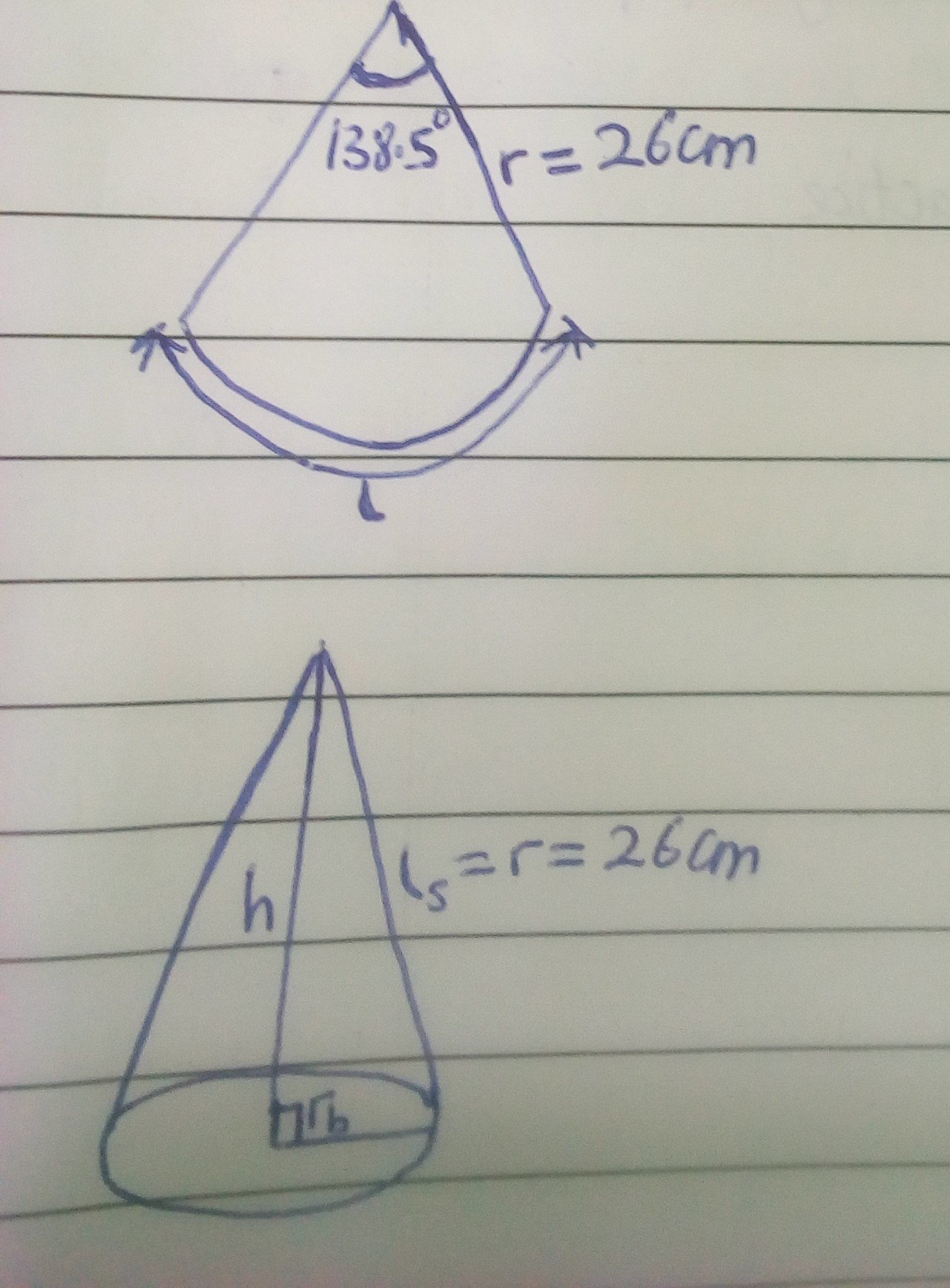
l = 2 π r b r b = l 2 π r b = 62.9 2 π r b = 10 c m l=2\pi r_b\\
r_b=\frac{l}{2\pi}\\
r_b=\frac{62.9}{2\pi}\\
r_b=10cm\\ l = 2 π r b r b = 2 π l r b = 2 π 62.9 r b = 10 c m
Slant height, cone height and base radius form a right-angle triangle
l s = r b 2 + h 2 l s = r = 26 c m h = 2 6 2 − 1 0 2 h = 24 c m l_s=\sqrt{r_b^2+h^2}\\
l_s=r=26cm\\
h=\sqrt{26^2-10^2}\\
h=24cm\\ l s = r b 2 + h 2 l s = r = 26 c m h = 2 6 2 − 1 0 2 h = 24 c m
Volume of cone is
V = 1 3 π r b 2 h V = 1 3 × 22 7 × 1 0 2 × 24 V = 2514 c m 3 V=\frac{1}{3}\pi r_b^2h\\
V=\frac{1}{3}\times\frac{22}{7}\times{10^2}\times{24}\\
V=2514cm^3 V = 3 1 π r b 2 h V = 3 1 × 7 22 × 1 0 2 × 24 V = 2514 c m 3
Comments

