Question #76193

Find domain and range of (answers should be subsets of R):

f(x)= x/(x^2+1)

Expert's answer

ANSWER on Question #76193 - Math - Discrete Mathematics

Find domain and range of (answers should be subsets of R\mathbb{R}):


y=f(x),f(x)=xx2+1y = f(x), f(x) = \frac{x}{x^2 + 1}

SOLUTION

f(x)=xx2+1Domain:x2+10f(x) = \frac{x}{x^2 + 1} \rightarrow \text{Domain}: x^2 + 1 \neq 0x2+10x21xRx^2 + 1 \neq 0 \rightarrow x^2 \neq -1 \rightarrow x \in \mathbb{R}


Conclusion,


f(x)=xx2+1Domain:xRf(x) = \frac{x}{x^2 + 1} \rightarrow \text{Domain}: x \in \mathbb{R}


Consider the range.

The first method


x2+12x because (x1)20,x^2 + 1 \geq 2x \text{ because } (x - 1)^2 \geq 0,x2+12x because (x+1)20.x^2 + 1 \geq -2x \text{ because } (x + 1)^2 \geq 0.


Divide inequalities x2+12xx^2 + 1 \geq 2x and x2+12xx^2 + 1 \geq -2x by x2+1>0x^2 + 1 > 0.

Then


12xx2+112-\frac{1}{2} \leq \frac{x}{x^2 + 1} \leq \frac{1}{2}


The second method


y=xx2+1,y = \frac{x}{x^2 + 1},

yx2x+y=0yx^2 - x + y = 0 is a quadratic equation in terms of xx,


D=14y20,D = 1 - 4y^2 \geq 0,


Hence y214y^{2} \leq \frac{1}{4} , that is, 12y12-\frac{1}{2} \leq y \leq \frac{1}{2} .

The third method.

1) We now find the asymptotic value of the function for x±x \to \pm \infty

limx+f(x)=limx+xx2+1=+0\lim _ {x \rightarrow + \infty} f (x) = \lim _ {x \rightarrow + \infty} \frac {x}{x ^ {2} + 1} = + 0limxf(x)=limxxx2+1=0\lim _ {x \rightarrow - \infty} f (x) = \lim _ {x \rightarrow - \infty} \frac {x}{x ^ {2} + 1} = - 0


2) Let us find the extremum points


f(x)=xx2+1f(x)=(x)(x2+1)x(x2+1)(x2+1)2=1(x2+1)x(2x)(x2+1)2==x2+12x2(x2+1)2=1x2(1+x2)2=(1x)(1+x)(1+x2)2f(x)=(1x)(1+x)(1+x2)2\begin{array}{l} f (x) = \frac {x}{x ^ {2} + 1} \rightarrow f ^ {\prime} (x) = \frac {(x) ^ {\prime} \cdot (x ^ {2} + 1) - x \cdot (x ^ {2} + 1) ^ {\prime}}{(x ^ {2} + 1) ^ {2}} = \frac {1 \cdot (x ^ {2} + 1) - x \cdot (2 x)}{(x ^ {2} + 1) ^ {2}} = \\ = \frac {x ^ {2} + 1 - 2 x ^ {2}}{(x ^ {2} + 1) ^ {2}} = \frac {1 - x ^ {2}}{(1 + x ^ {2}) ^ {2}} = \frac {(1 - x) (1 + x)}{(1 + x ^ {2}) ^ {2}} \rightarrow \boxed {f ^ {\prime} (x) = \frac {(1 - x) (1 + x)}{(1 + x ^ {2}) ^ {2}}} \\ \end{array}f(x)=0(1x)(1+x)(1+x2)2=0[1x=01+x=0[x=1x=1]f ^ {\prime} (x) = 0 \rightarrow \frac {(1 - x) (1 + x)}{(1 + x ^ {2}) ^ {2}} = 0 \rightarrow \left[\begin{array}{l}1 - x = 0\\1 + x = 0\end{array}\right. \rightarrow \boxed {\left[\begin{array}{l}x = 1\\x = - 1\end{array}\right]}minxRf(x)=f(1)=1(1)2+1=12\min _ {x \in \mathbb {R}} f (x) = f (- 1) = \frac {- 1}{(- 1) ^ {2} + 1} = - \frac {1}{2}maxxRf(x)=f(1)=112+1=12\max _ {x \in \mathbb {R}} f (x) = f (1) = \frac {1}{1 ^ {2} + 1} = - \frac {1}{2}


3) Let's sketch this function using the received data
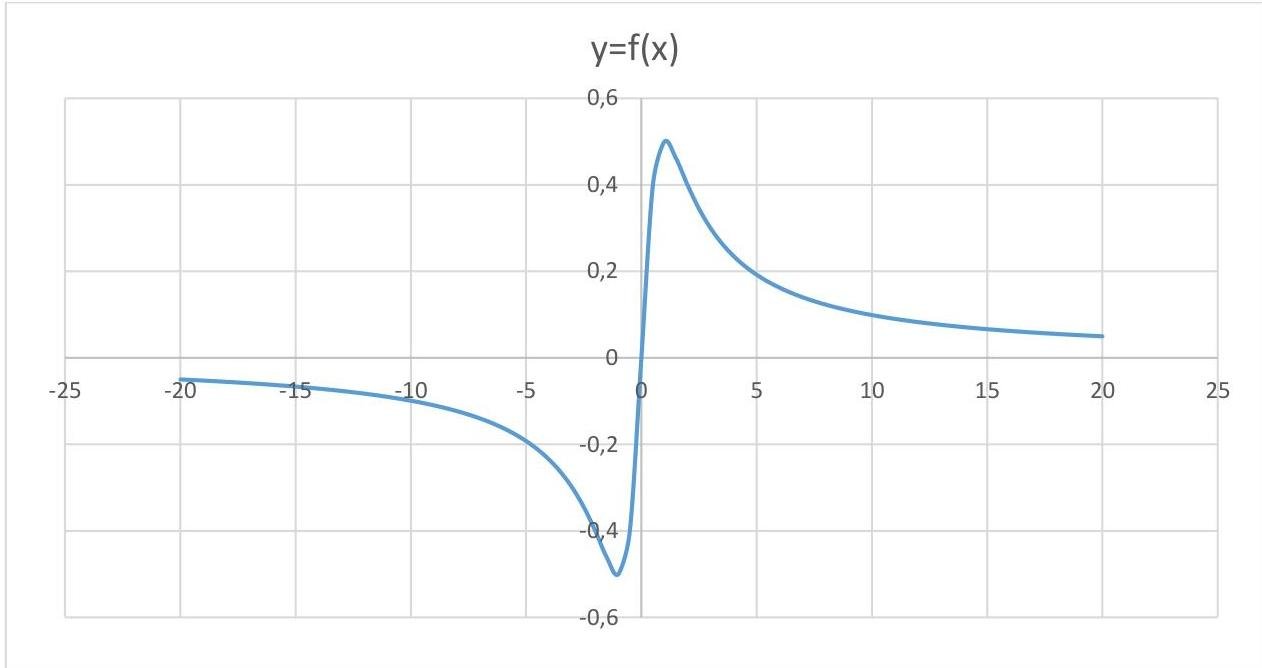


As we see from the sketch, the local extrema are global maxima and minima/ Then,


y=f(x)=xx2+1Range:y[12;12]y = f (x) = \frac {x}{x ^ {2} + 1} \rightarrow R a n g e: y \in \left[ - \frac {1}{2}; \frac {1}{2} \right]


ANSWER:


y=f(x),f(x)=xx2+1Domain:xRy = f (x), f (x) = \frac {x}{x ^ {2} + 1} \rightarrow D o m a i n: x \in \mathbb {R}y=f(x),f(x)=xx2+1Range:y[12;12].y = f (x), f (x) = \frac {x}{x ^ {2} + 1} \rightarrow R a n g e: y \in \left[ - \frac {1}{2}; \frac {1}{2} \right].


Answer provided by https://www.AssignmentExpert.com

Need a fast expert's response?

Submit order

and get a quick answer at the best price

for any assignment or question with DETAILED EXPLANATIONS!

LATEST TUTORIALS
APPROVED BY CLIENTS

