Solution.
f ( x ) = x 4 4 − 3 x 2 2 f(x)=\frac{x^4}{4}-\frac{3x^2}{2} f ( x ) = 4 x 4 − 2 3 x 2
Find f ′ ( x ) = 4 x 3 4 − 3 2 x 2 = x 3 − 3 x . f'(x)=4\frac{x^3}{4}-3\frac{2x}{2}=x^3-3x. f ′ ( x ) = 4 4 x 3 − 3 2 2 x = x 3 − 3 x .
Make and solve equation f ′ ( x ) = 0. f'(x)=0. f ′ ( x ) = 0.
x 3 − 3 x = 0 , x ( x 2 − 3 ) = 0 , x 1 = 0 , or x 2 = 3 , or x 3 = − 3 . x^3-3x=0,\newline
x(x^2-3)=0,\newline
x_1=0, \text{ or }x_2=\sqrt{3},\text{ or }x_3=-\sqrt{3}. x 3 − 3 x = 0 , x ( x 2 − 3 ) = 0 , x 1 = 0 , or x 2 = 3 , or x 3 = − 3 .
Investigate the sign of the derivative at each interval:
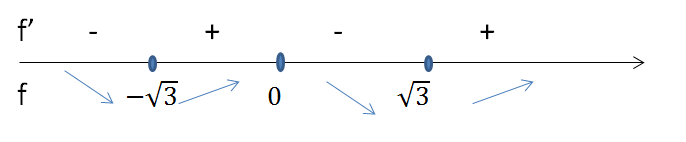
From here 3 \sqrt{3} 3 and − 3 -\sqrt{3} − 3 are minimum points, is maximum point.
f m i n ( 3 ) = 3 4 4 − 3 3 2 2 = 9 4 − 9 2 = − 9 4 = − 2 1 4 . f_{min}(\sqrt{3})=\frac{\sqrt{3}^4}{4}-\frac{3\sqrt{3}^2}{2}=\frac{9}{4}-\frac{9}{2}=
-\frac{9}{4}=-2\frac{1}{4}. f min ( 3 ) = 4 3 4 − 2 3 3 2 = 4 9 − 2 9 = − 4 9 = − 2 4 1 .
f m i n ( − 3 ) = ( − 3 ) 4 4 − 3 ( − 3 ) 2 2 = 9 4 − 9 2 = − 9 4 = − 2 1 4 . f_{min}(-\sqrt{3})=\frac{(-\sqrt{3})^4}{4}-\frac{3(-\sqrt{3})^2}{2}=\frac{9}{4}-\frac{9}{2}=
-\frac{9}{4}=-2\frac{1}{4}. f min ( − 3 ) = 4 ( − 3 ) 4 − 2 3 ( − 3 ) 2 = 4 9 − 2 9 = − 4 9 = − 2 4 1 .
f m a x ( 0 ) = 0. f_{max}(0)=0. f ma x ( 0 ) = 0.
Answer. f m i n = − 2 1 4 , f m a x = 0. f_{min}=-2\frac{1}{4}, f_{max}=0. f min = − 2 4 1 , f ma x = 0.
Comments

