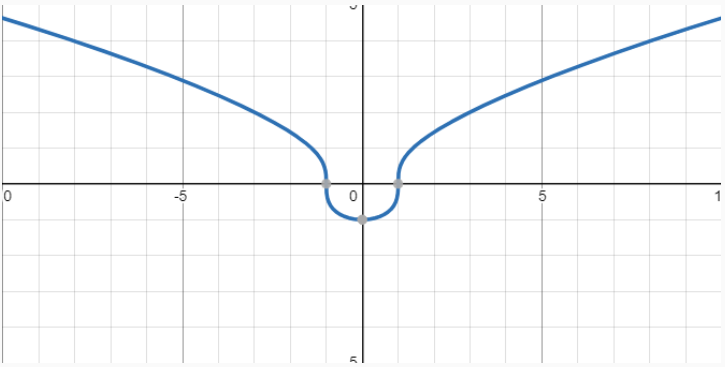
y = x 2 − 1 3 y=\sqrt[3]{x^2-1} y = 3 x 2 − 1
1) The domain x ∈ ( − ∞ ; ∞ ) x\in(-\infty;\infty) x ∈ ( − ∞ ; ∞ ) .
2) Evenness, oddity
y ( − x ) = ( − x ) 2 − 1 3 = x 2 − 1 3 = y ( x ) y(-x)=\sqrt[3]{(-x)^2-1}=\sqrt[3]{x^2-1}=y(x) y ( − x ) = 3 ( − x ) 2 − 1 = 3 x 2 − 1 = y ( x )
graph is symmetric about the axis O y Oy O y .
3) Continuity
the function is continuous x ∈ ( − ∞ ; ∞ ) x\in (-\infty;\infty) x ∈ ( − ∞ ; ∞ )
4) Periodicity
the function is not periodic
5) Intersection points with coordinate axes
O x : y = 0 x 2 − 1 3 = 0 x 2 − 1 = 0 x 2 = 1 x 1 = 1 , x 2 = − 1 A ( 1 , 0 ) , B ( − 1 , 0 ) O y : x = 0 y = 0 2 − 1 3 = − 1 3 = − 1 C ( 0 , − 1 ) Ox: y=0\\
\sqrt[3]{x^2-1}=0\\
x^2-1=0\\
x^2=1\\
x_1=1, x_2=-1\\
A(1,0), B(-1,0)\\
Oy:x=0\\
y=\sqrt[3]{0^2-1}=\sqrt[3]{-1}=-1\\
C(0,-1) O x : y = 0 3 x 2 − 1 = 0 x 2 − 1 = 0 x 2 = 1 x 1 = 1 , x 2 = − 1 A ( 1 , 0 ) , B ( − 1 , 0 ) O y : x = 0 y = 3 0 2 − 1 = 3 − 1 = − 1 C ( 0 , − 1 )
6) Let's check the extremum
y ′ = ( ( x 2 − 1 ) 1 3 ) ′ = 2 3 ⋅ x ⋅ ( x 2 − 1 ) − 2 3 y ′ = 0 2 3 ⋅ x ⋅ ( x 2 − 1 ) − 2 3 = 0 x 1 = 0 , x 2 = 1 , x 3 = − 1 x ∈ ( − ∞ ; − 1 ) ∪ ( − 1 ; 0 ] , y ↘ x ∈ [ 0 ; 1 ) ∪ ( 1 , ∞ ) , y ↗ x = 0 − m i n y m i n = − 1 y'=((x^2-1)^\frac{1}{3})'=\frac{2}{3}\cdot x\cdot(x^2-1)^{-\frac{2}{3}}\\
y'=0\\
\frac{2}{3}\cdot x\cdot(x^2-1)^{-\frac{2}{3}}=0\\
x_1=0, x_2=1, x_3=-1\\
x\in(-\infty;-1)\cup(-1;0], y\searrow\\
x\in [0;1)\cup(1,\infty),y\nearrow\\
x=0-min\\
y_{min}=-1 y ′ = (( x 2 − 1 ) 3 1 ) ′ = 3 2 ⋅ x ⋅ ( x 2 − 1 ) − 3 2 y ′ = 0 3 2 ⋅ x ⋅ ( x 2 − 1 ) − 3 2 = 0 x 1 = 0 , x 2 = 1 , x 3 = − 1 x ∈ ( − ∞ ; − 1 ) ∪ ( − 1 ; 0 ] , y ↘ x ∈ [ 0 ; 1 ) ∪ ( 1 , ∞ ) , y ↗ x = 0 − min y min = − 1
7) Convex intervals
y ′ ′ = 2 3 ( x 2 − 1 ) − 2 3 − 8 9 ⋅ x 2 ⋅ ( x 2 − 1 ) − 5 3 y ′ ′ = 0 2 3 ( x 2 − 1 ) − 2 3 − 8 9 ⋅ x 2 ⋅ ( x 2 − 1 ) − 5 3 = 0 ( x 2 − 1 ) − 5 3 ( x 2 − 1 − 4 3 x 2 ) = 0 x 1 = − 1 , x 2 = 1 , 1 3 x 2 = − 1 x ∈ ( − ∞ ; − 1 ) ∪ ( 1 , ∞ ) y''=\frac{2}{3}(x^2-1)^{-\frac{2}{3}}-\frac{8}{9}\cdot x^2\cdot(x^2-1)^{-\frac{5}{3}}\\
y''=0\\
\frac{2}{3}(x^2-1)^{-\frac{2}{3}}-\frac{8}{9}\cdot x^2\cdot(x^2-1)^{-\frac{5}{3}}=0\\
(x^2-1)^{-\frac{5}{3}}(x^2-1-\frac{4}{3}x^2)=0\\
x_1=-1,x_2=1, \frac{1}{3}x^2=-1\\
x\in (-\infty;-1)\cup(1,\infty) y ′′ = 3 2 ( x 2 − 1 ) − 3 2 − 9 8 ⋅ x 2 ⋅ ( x 2 − 1 ) − 3 5 y ′′ = 0 3 2 ( x 2 − 1 ) − 3 2 − 9 8 ⋅ x 2 ⋅ ( x 2 − 1 ) − 3 5 = 0 ( x 2 − 1 ) − 3 5 ( x 2 − 1 − 3 4 x 2 ) = 0 x 1 = − 1 , x 2 = 1 , 3 1 x 2 = − 1 x ∈ ( − ∞ ; − 1 ) ∪ ( 1 , ∞ )
since the second derivative is at this interval
y ′ ′ < 0 y''<0 y ′′ < 0 then
y y y is convex upward ∩ \cap ∩
x ∈ ( − 1 , 1 ) x\in (-1,1) x ∈ ( − 1 , 1 )
since the second derivative is at this interval
y ′ ′ > 0 y''>0 y ′′ > 0 then
y y y is convex down ∪ \cup ∪
x = 1 , x = − 1 x=1, x=-1 x = 1 , x = − 1 are inflection points
8) Asymptotes
there are no vertical asymptotes
find oblique, horizontal asymptote y = k x + b y=kx+b y = k x + b
k = lim x → ∞ f ( x ) x = lim x → ∞ x 2 − 1 3 x = 0 b = lim x → ∞ ( f ( x ) − k x ) = lim x → ∞ ( x 2 − 1 3 − 0 ) = ∞ k=\lim\limits_{ x\to\infty}\frac{f(x)}{x}=\lim\limits_{ x\to\infty}\frac{\sqrt[3]{x^2-1}}{x}=0\\
b=\lim\limits_{ x\to\infty}(f(x)-kx)=\lim\limits_{ x\to\infty}(\sqrt[3]{x^2-1}-0)=\infty k = x → ∞ lim x f ( x ) = x → ∞ lim x 3 x 2 − 1 = 0 b = x → ∞ lim ( f ( x ) − k x ) = x → ∞ lim ( 3 x 2 − 1 − 0 ) = ∞
there are no oblique, horizontaltical asymptote y = k x + b y=kx+b y = k x + b
9)
lim x → − ∞ x 2 − 1 3 = + ∞ lim x → ∞ x 2 − 1 3 = + ∞ \lim\limits_{x\to -\infty}\sqrt[3]{x^2-1}=+\infty\\
\lim\limits_{x\to\infty}\sqrt[3]{x^2-1}=+\infty x → − ∞ lim 3 x 2 − 1 = + ∞ x → ∞ lim 3 x 2 − 1 = + ∞
Comments