Answer on Question #58344 – Math – Analytic Geometry
Question
Triangle ABC is rotated to create the image A'B'C'. Which rule describes the transformation?
Solution
In two dimensions (in a plane)
For example, in a plane the triangle ABC is rotated about O through φ angle in an counterclockwise direction.
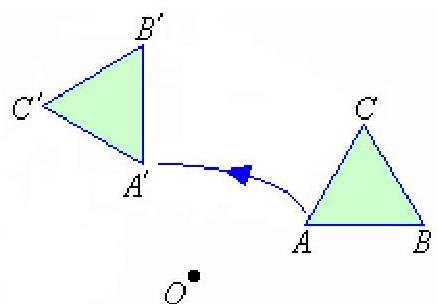
Triangle rotated about point O
Usually rotations on a coordinate grid are considered to be counterclockwise, unless otherwise stated.
In analytic geometry a counterclockwise rotation in Cartesian coordinates is expressed by the following formulae:
x′=xcosφ−ysinφy′=xsinφ+ycosφ
If point A has coordinates (xA,yA), then after a counterclockwise rotation through φ angle the coordinates of point A' will be
xA′=xAcosφ−yAsinφyA′=xAsinφ+yAcosφ
Particular cases are as follows:
- Rotation of 0∘ on coordinate axes
xA′=xAyA′=yA
- Rotation of 90∘ on coordinate axes
xA′=−yAyA′=xA
- Rotation of 180∘ on coordinate axes (in either direction it is a half-turn)
xA′=−xAyA′=−yA
- Rotation of 270∘ on coordinate axes (270∘ counterclockwise rotation is the same as a 90∘ clockwise direction)
xA′=yAyA′=−xA
In analytic geometry a clockwise rotation in Cartesian coordinates is expressed by the following formulae:
x′=xcosφ+ysinφy′=−xsinφ+ycosφIn three dimensions (in a space)
If point A has coordinates (xA,yA,zA), then after rotation trough φ angle about the x axis the coordinates of point A' will be
xA′=xAyA′=yAcosφ−zAsinφzA′=yAsinφ+zAcosφ
If point A has coordinates (xA,yA,zA), then after rotation trough φ angle about the y axis the coordinates of point A' will be
xA′=xAcosφ+zAsinφyA′=yAyA′=−xAsinφ+zAcosφ
If point A has coordinates (xA,yA,zA), then after rotation trough φ angle about the z axis the coordinates of point A' will be
xA′=xAcosφ−yAsinφyA′=xAsinφ+yAcosφzA′=zA
Any other rotation in three-dimensional space can be obtained from these three.
Answer:
Rule which describes the transformation in a plane (where φ is an angle of rotation):
x′=xcosφ−ysinφy′=xsinφ+ycosφ
www.AssignmentExpert.com



