Question #55350

A quadrilateral has vertices A(−3, 1), B(1, 8), C(6, 7), and D(5, 2). What kind of quadrilateral is it? Explain using the vectors.
1

Expert's answer

2015-10-08T09:02:39-0400

Answer on Question #55350 – Math – Analytic Geometry

A quadrilateral has vertices A(3,1)A(-3, 1), B(1,8)B(1, 8), C(6,7)C(6, 7), and D(5,2)D(5, 2). What kind of quadrilateral is it? Explain using the vectors.

Solution

Draw a rectangle ABCD in the Cartesian coordinate system
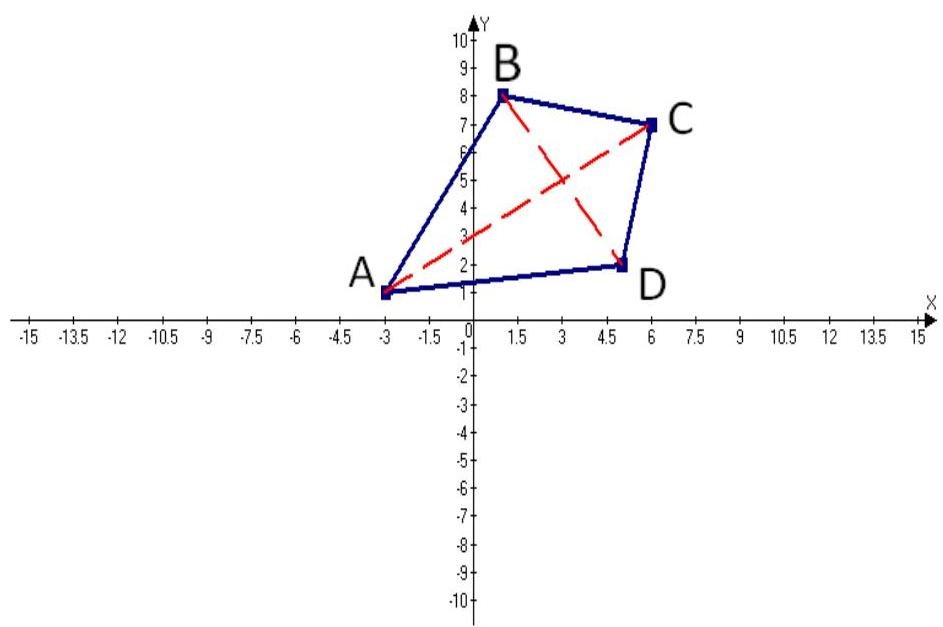


Consider the sides of the quadrilateral as vectors.

We find coordinates and moduli of vectors AB,BC,CD,DA\overrightarrow{AB}, \overrightarrow{BC}, \overrightarrow{CD}, \overrightarrow{DA}.

Coordinates


AB=(xBxA;yByA)=(1(3);81)=(1+3;81)=(4;7);\overrightarrow{AB} = (x_B - x_A; y_B - y_A) = (1 - (-3); 8 - 1) = (1 + 3; 8 - 1) = (4; 7);


modulus


AB=xAB2+yAB2=42+72=65.\left| \overrightarrow{AB} \right| = \sqrt{x_{AB}^2 + y_{AB}^2} = \sqrt{4^2 + 7^2} = \sqrt{65}.


Coordinates


BC=(xCxB;yCyB)=(61;78)=(5;1);\overrightarrow{BC} = (x_C - x_B; y_C - y_B) = (6 - 1; 7 - 8) = (5; -1);


modulus


BC=xBC2+yBC2=52+(1)2=26.\left| \overrightarrow{BC} \right| = \sqrt{x_{BC}^2 + y_{BC}^2} = \sqrt{5^2 + (-1)^2} = \sqrt{26}.


Coordinates


CD=(xDxC;yDyC)=(56;27)=(1;5);\overrightarrow{CD} = (x_D - x_C; y_D - y_C) = (5 - 6; 2 - 7) = (-1; -5);


modulus


CD=xCD2+yCD2=(1)2+(5)2=26.\left| \overrightarrow {C D} \right| = \sqrt {x _ {C D} ^ {2} + y _ {C D} ^ {2}} = \sqrt {(- 1) ^ {2} + (- 5) ^ {2}} = \sqrt {2 6}.


Coordinates


DA=(xAxD;yAyD)=(35;12)=(8;1);\overrightarrow {D A} = \left(x _ {A} - x _ {D}; y _ {A} - y _ {D}\right) = (- 3 - 5; 1 - 2) = (- 8; - 1);


modulus


DA=xDA2+yDA2=(8)2+(1)2=65.\left| \overrightarrow {D A} \right| = \sqrt {x _ {D A} ^ {2} + y _ {D A} ^ {2}} = \sqrt {(- 8) ^ {2} + (- 1) ^ {2}} = \sqrt {6 5}.


As the vectors are not collinear, then the sides are not parallel. Notice that the sides of a quadrilateral are pairwise identical: AB=AD and CB=CD.

According to the definition, this quadrilateral is a deltoid, also known as a kite.

A kite is a quadrilateral whose four sides can be grouped into two pairs of equal-length sides that are adjacent to each other.

Answer: this quadrilateral is a deltoid.

www.AssignmentExpert.com


Need a fast expert's response?

Submit order

and get a quick answer at the best price

for any assignment or question with DETAILED EXPLANATIONS!

Comments

No comments. Be the first!
LATEST TUTORIALS
APPROVED BY CLIENTS
