Answer on Question #87789 – Math – Algebra
Question
Suppose that a ball is thrown straight up into the air and its height after t second is 4+48t−16t2 meters. Determine how long it will take for the ball to reach its maximum height and determined the maximum height.
Solution
The given problem states that height (H) is a function of time (t), governed by the equation: H=f(t)=4+48t−16t2
Now to obtain extrema (maxima or minima) of the height, we have to obtain the derivative of height with respect to time and have to be equated to zero. So, accordingly we get:
H=f(t)=4+48t−16t2⇒dtdH={48×(dtdt)}−{16×dtd(t2)}⇒dtdH=48−(16×2×t)⇒dtdH=48−(32×t)⇒0=48−(32×t)⇒32×t=48⇒t=(3248)sec=(23)sec=1.5sec
Now, it is understood that at t=1.5sec, the ball will reach extreme height, either maximum or minimum height. But to know, whether it is reaching maximum or minimum height, we need to have double derivative of height with respect to time. As per the theory of maxima-minima, if double derivative of function is positive, the corresponding situation is minima. And on the other hand, if double derivative of a function is negative, the corresponding situation is maxima. So, we get:
H=f(t)=4+48t−16t2⇒dtdH={48×(dtdt)}−{16×dtd(t2)}⇒dtdH=48−(16×2×t)⇒dtdH=48−(32×t)⇒dt2d2H=dtd(dtdH)=dtd{48−(32×t)}=−32<0
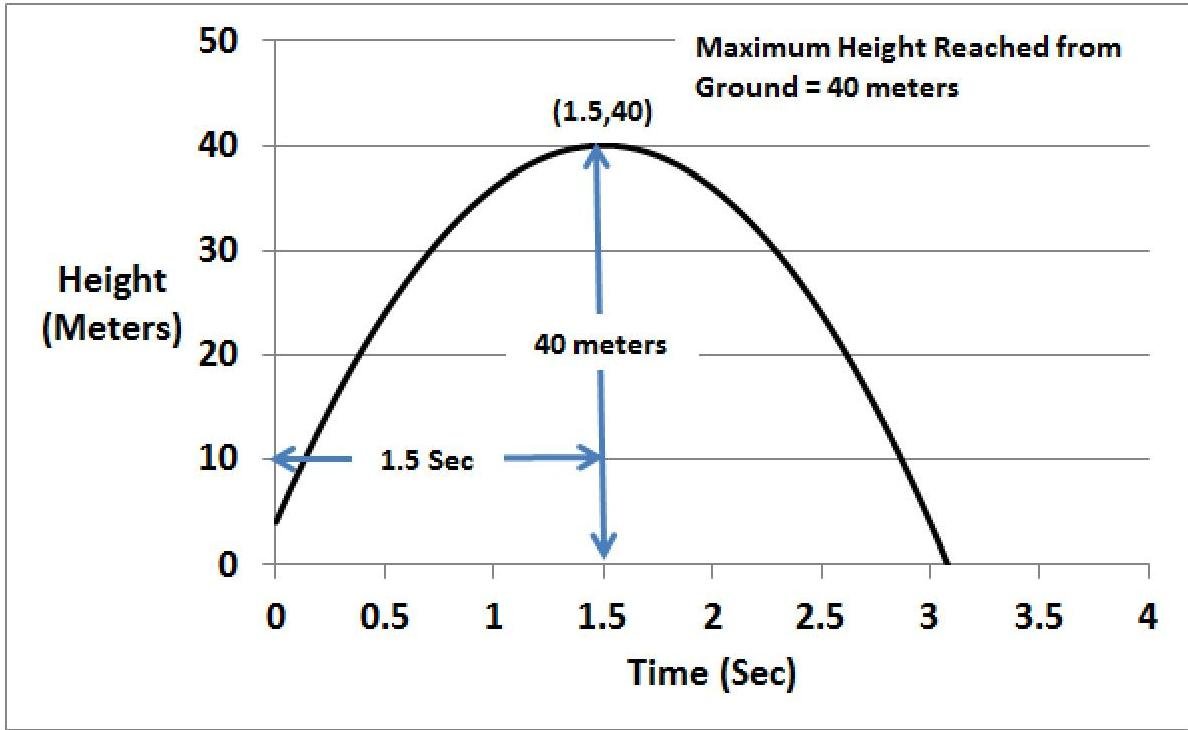
So, finally, it is seen that dt2d2H<0. So, the height reached is maxima and as obtained above, maximum height is reached at t=1.5sec.
Accordingly, at t=1.5sec, the height reached from ground can be calculated as:
H=f(t)=4+48t−16t2⇒H=f(1.5)=4+(48×1.5)−(16×1.52)⇒H=f(23)=4+{48×(23)}−{16×(23)2}⇒H=4+{48×(23)}−{16×(23)2}⇒H=4+72−{16×(49)}⇒H=(4+72−36)=40m
So, the time taken to reach maximum height is 1.5 sec and the maximum height reached from ground is 40 meters. Below, we try to plot the situation to understand it better.
Answer provided by https://www.AssignmentExpert.com



 #340153 on Dec 2023