The proof consists of several parts which we will give for completeness. Let K denote kerf. The following calculation validates that for every g∈G and k∈K :
f(gkg−1)=f(g)f(k)f(g)−1(fi s a n h o m o m o r p h i s m)=f(g)1Hf(g)−1(d e f i n i t i o n o fK)=1H
Hence, gkg−1 is in K . Therefore, K is a normal subgroup of G and G/K is well-defined.
To prove the theorem we will define a map from G/K to the image of f and show that it is a function, a homomorphism and finally an isomorphism.
Let θ:G/K⟶Imf be a map that sends the coset gK to f(g) .
Since θ is defined on representatives we need to show that it is well defined. So, let g1 and g2 be two elements of G that belong to the same coset (i.e. g1K=g2K ). Then, g1−1g2 is an element of K and therefore f(g1−1g2)=1 (because K is the kernel of G ). Now, the rules of homomorphism show that f(g1)−1f(g2)=1 and that is equivalent to f(g1)=f(g2) which implies the equality θ(g1K)=θ(g2K) .
Next we verify that θ is a homomorphism. Take two cosets g1K and g2K , then:
θ(g1K⋅g2K)=θ(g1g2K)(o p e r a t i o n i nG/K)=f(g1g2)(d e f i n i t i o n o fθ)=f(g1)f(g2)(fi s a n h o m o m o r p h i s m)=θ(g1K)θ(g2K)(d e f i n i t i o n o fθ)
Finally, we show that θ is an isomorphism (i.e. a bijection). The kernel of θ consists of all cosets gK in G/K such that f(g)=1 but these are exactly the elements g that belong to K so only the coset K is in the kernel of θ which implies that θ is an injection. Let h be an element of Imf and g its pre-image. Then, θ(gK) equals f(g) thus θ(gK)=h and therefore θ is surjective.
The theorem is proved. Some version of the theorem also states that the following diagram is commutative:
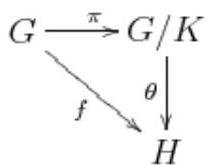
were π is the natural projection that takes g∈G to gK . We will conclude by verifying this. Take g in G then, θ(π(g))=θ(gK)=f(g) as needed.



