Tris(hydroxymethyl)aminomethane (or THAM) is a weak base frequently used to prepare buffers in biochemistry. Its pKb is 5.92. The corresponding pKa is 8.08 near the pH of physiological buffers, thus it exhibits good buffering capacity at physiological pH. What is the mass of THAM must be taken with 100mL of 0.50M HCl to prepare 1 L of a pH 7.40 buffer?
Solution:
The formula for calculating pH of the buffer solution is following:
pH=pKa+lg(base/[acid])
Tris has the next structure formula:
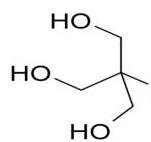
For the convenience, it also can be presented as RNH₂, where R is for all that big organic radical.
Buffer solution is a solution where two forms (acid form RNH₃⁺ and base form RNH₂) are present and are related with the following ionic equation:
RNH3+=RNH2+H+
To prepare buffer solution you need to take RNH₂ and mix it with HCl to get it's salt:
RNH2+HCl=RNH3Cl(1)
The formula for pH in our case is:
pH=pKa+lg([RNH2]/[RNH3+])pH=7,4;pKa=8,08;7,4=8,08+lg([RNH2]/[RNH3+]);−0,68=lg([RNH2]/[RNH3+]);[RNH2]/[RNH3+]=10−0,68;[RNH2]/[RNH3+]=0,2089(2)
The quantity of moles of HCl is v(HCl)=c(HCl)∗V(HCl)=0,5∗0,1=0,05. From the equation (1) it is obvious that if 0,05 moles of HCl react with RNH20,05 moles of RNH3+ are formed. So, v(HCl)=[RNH3+]=0,05 mol. After putting this value in equation (2) one gets [RNH2]=0,05∗0,2089=0,010445 mol.
Total amount of RNH2 is that which reacts with HCl (0,05 moles) and that which must be left to form a buffer of required properties (0,010445 moles). So,
v(RNH2)Total=0,05+0,010445=0,060445 (mol).m(RNH2)=v(RNH2)∗M(RNH2)=0,060445∗121,14=7,3223 (g).
Answer: m(RNH2)=7,3223 (g).



 #340153 on Dec 2023