Question #31844

derive the term of H2 molecule in ground and excited state

Expert's answer


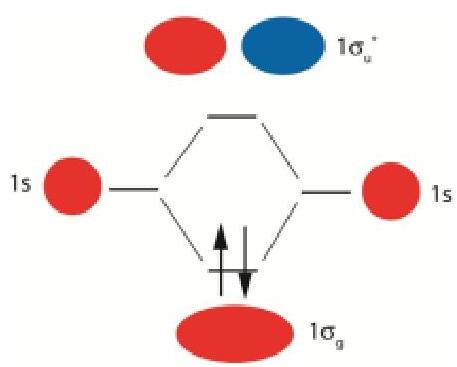
To discuss electronic transitions, we first need an efficient way to describe these states. First, we will use our MO diagrams to construct electron configurations. For H2\mathrm{H}_{2} , the MO diagram leads to the electron configuration (1σg)2(1\sigma_{\mathrm{g}})^{2} . Now, we can use these configurations to define molecular term symbols which describe the electronic state of the molecule.

Begin by adding the angular momentum and spin for each electron together:


ML=i=1nmi,MS=i=1nmsiM _ {L} = \sum_ {i = 1} ^ {n} m _ {\ell_ {i}}, \quad M _ {S} = \sum_ {i = 1} ^ {n} m _ {s _ {i}}


Electron in σ\sigma orbital: m=0m = 0 . Electron in π\pi orbital: m=1m = 1 .

Then, we calculate the allowed values of the total angular momentum (L) and spin (S) from:


LMLL,SMSS- L \leq M _ {L} \leq L, \quad - S \leq M _ {S} \leq S


With L and S, molecular term symbols are constructed as follows:


2S+1Λg/u,Λ=ML{ } ^ { 2 S + 1 } \Lambda _ { g / u } , \quad \Lambda = \left| M _ { L } \right|


We have a shorthand to keep track of \wedge values:


Λ0123\begin{array}{c c c c c} \Lambda & 0 & 1 & 2 & 3 \end{array}ΣΠΔΦ\Sigma \quad \Pi \quad \Delta \quad \Phi


Finally, g\mathbf{g} or u\mathbf{u} subscript is determined using the following symmetry relationships:


g×g=u×u=g,u×g=g×u=ug \times g = u \times u = g, \quad u \times g = g \times u = u


Let's apply these rules to H2\mathrm{H}_2 :


(1σ0)2ML=0+0=0,MS=12+(12)=0L=0,S=0g×g=g2S+1Λg/u1Σg\begin{array}{l} (1 \sigma_ {0}) ^ {2} \\ M _ {L} = 0 + 0 = 0, \quad M _ {S} = \frac {1}{2} + \left(- \frac {1}{2}\right) = 0 \\ L = 0, \quad S = 0 \\ g \times g = g \\ { } ^ { 2 S + 1 } \Lambda _ { g / u } \Rightarrow { } ^ { 1 } \Sigma _ { g } \\ \end{array}


Excited state of H2: (1σ0)(1σu)(1\sigma_0)(1\sigma_u^*)

Now the electrons do not have to be spin paired; therefore, we have the possibility of both singlet and triplet states!


ML=0+0=0,MS=1,0,1L=0,S=0,1g×u=u2S+1Λg/u1Σu,3Σu\begin{array}{l} M _ {L} = 0 + 0 = 0, \quad M _ {S} = - 1, 0, 1 \\ L = 0, \quad S = 0, 1 \\ g \times u = u \\ { } ^ { 2 S + 1 } \Lambda _ { g / u } \Rightarrow { } ^ { 1 } \Sigma _ { u } , { } ^ { 3 } \Sigma _ { u } \\ \end{array}


Hund's Rule: State with greatest spin multiplicity is lowest in energy.

Need a fast expert's response?

Submit order

and get a quick answer at the best price

for any assignment or question with DETAILED EXPLANATIONS!

LATEST TUTORIALS
APPROVED BY CLIENTS
