Question #61746, Chemistry / Inorganic chemistry
Discuss the formation, reactions and structures of oxides of sulphur and selenium.
Answer
Both sulfur and selenium can form oxides with formula EO2 and EO3 .
Sulfur (IV) oxide can be easily obtained from the reaction between simple elements, burning of the sulfides, by the reduction of S(VI) compounds or by the replacement reaction between sulfides with strong acids:
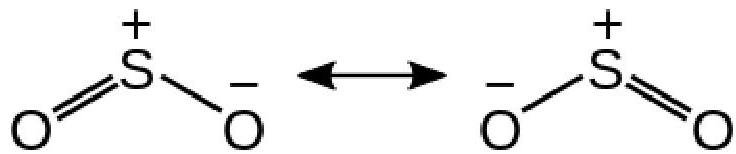
S+O2=SO24FeS2+11O2=2Fe2O3+8SO22CaSO4+C=2CaO+2SO2+CO2Na2SO3+H2SO4=Na2SO4+SO2+H2OSO2 is a bent molecule with C2v symmetry point group. In terms of electron-counting formalism, the sulfur atom has an oxidation state of +4 and a formal charge of +1 . A valence bond theory approach considering just s and p orbitals would describe the bonding in terms of resonance between two resonance structures.
Sulfur (IV) oxide shows classical properties of the acidic oxide. It forms weak acid – H2SO3 and reacts with bases forming sulfite and hydrosulfite salts.
SO2+NaOH=NaHSO3SO2+2NaOH=Na2SO3+H2O
It is strong reducing agent and weak oxidizing agent.
2SO2+O2=2SO3SO2+C=S+CO2
Sulfur (VI) oxide is usually obtained by oxidizing sulfur (IV) oxide, what was shown above.
Gaseous SO3 is a trigonal planar molecule of D3h symmetry. In terms of electron-counting formalism, the sulfur atom has an oxidation state of +6 and a formal charge of +2 . The Lewis structure consists of an S=O double bond and two S−O dative bonds without utilizing d-orbitals. The electrical dipole moment of gaseous sulfur trioxide is zero. This is a consequence of the 120∘ angle between the S-O bonds.
It is classical acidic oxide, reacts with vases forming sulfates and hydrosulfates< anhydride to the sulfuric acid. Can react with sulfuric acid with formation of H2S2O7 , with hydro halides.
SO3+NaOH=NaHSO4SO3+NaOH=Na2SO4+H2OSO3+HF=HSO3F
Selenium (IV) oxide is obtained similar to the SO2, main method is the reaction of simple elements.
Se+O2=SeO2
In contrast to the SO2, SeO2 is solid one-dimensional polymer, the chain consisting of alternating selenium and oxygen atoms. SeO2 is considered an acidic oxide, with corresponding selenous acid, but it is weaker in comparison to the SO2. Due to the +4 oxidation it can react as strong reducing agent and weak oxidizing agent.
SeO2+NaOH=NaHSeO3SeO2+2NaOH=Na2SeO3+H2OSeO2+H2O2=H2SeO4SeO2+N2H4+H2O=Se+N2+3H2O
Selenium (VI) oxide, in contrast to the SO3, can't be obtained by directed oxidation of the selenium. So it's obtained from its salts
SO3+K2SeO4=K2SO4+SeO3
Structure of the SeO3 is similar to the SO3. It is solid, which can be easily sublimated. SeO3 is acidic oxide, with corresponding selenic acids and its salts. It easily decomposes on heating to the SeO2, is strong oxidizing agents.
2SeO3=2SeO2+O2SeO3+H2O=H2SeO4SeO3+2HCl=SeO2+Cl2+H2O
https://www.AssignmentExpert.com



 #339914 on Dec 2023