Question#47012 – Chemistry – Inorganic Chemistry
Question:
At 25 degree Celsius the vapor pressure of pure water is 27.76 mmHg and that of a dilute solution aqueous urea solution is 22.98 mmHg. Estimate the molality of solution.
Answer:
Vapor pressure of solvent decreases with the presence of solute because of the reduction of evaporation surface. This phenomenon is illustrated with a picture below.
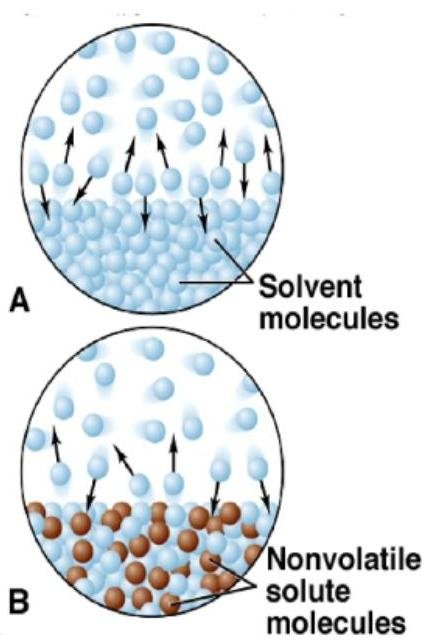
The decrease in vapor pressure is defined by Raoult’s law:
psolvent=χsolvent×psolvent0(1)
where psolvent0 is a vapor pressure under pure solvent and χ is a molar fraction, defined as:
χsolvent=nsolvent+nsolutensolvent(2)
One can calculate the molar fraction of the given solution from equation (1):
χsolvent=psolvent0psolvent=27.76 mmHg22.98 mmHg=0.8278
Molality can be defined as the amount of moles of solute per one kilogram of solvent:
Cm=msolvent1000×nsolute(3)
Equation (3) is for mass in grams.
We can show that the molar fraction of solute is related to molar fraction of solvent with the following equation:
χ solute=n solvent+n soluten solute=1−χ solvent(4)
Molality (3) is related with molar fraction of solute (4) according to the equation:
Cm=(1−χ solute )M solute 1000χ solute =χ solvent M solvent 1000(1−χ solvent )(5)
In our case solvent is water H2O and solute is urea CO(NH2)2. According to the equation (5):
Cm(CO(NH2)2)=χH2OMCO(NH2)21000(1−χH2O)=0.8278×18 g/mol1000×(1−0.8278)=3.47 mol/kg


